billionaires trick

The topic of “Wealth Beyond Tier-1 Cities: Deciphering the Fundamentals that Make Bharat’s Billionaires Tick” is an intriguing one, particularly in light of the rapid growth of India’s economy and its increasingly decentralized wealth creation. It suggests an exploration of how billionaires in smaller towns, cities, and rural regions—outside the traditional Tier-1 cities like Delhi, Mumbai, and Bangalore—are achieving success. This shift challenges the conventional view that major metropolitan centers are the only hubs for generating substantial wealth.
Let’s break down some potential fundamentals that could explain why and how billionaires are emerging beyond India’s Tier-1 cities:
1. Emergence of Tier-2 and Tier-3 Cities as Business Hubs
- Localized Innovation: In smaller cities, entrepreneurs are often addressing unique regional problems or needs that aren’t being met in the bigger cities. For example, setting up regional manufacturing or developing region-specific tech products.
- Market Saturation in Tier-1: Major cities are becoming increasingly saturated with businesses and competition. Entrepreneurs in smaller cities find less competitive environments and untapped market potential, allowing for faster growth.
- E-commerce and Digital Transformation: The growth of online platforms, e-commerce, and digital tools has made it easier for businesses to expand beyond their immediate geographic locations. Small-town entrepreneurs can now reach a global market through online platforms.
2. Lower Cost of Doing Business
- Cheaper Real Estate: The cost of land, office space, and labor is significantly lower in smaller cities compared to Tier-1 cities. This allows entrepreneurs to start businesses with lower initial investment and overheads.
- Government Incentives: Many state governments in smaller regions have introduced incentives like tax breaks, subsidies, and grants to promote business activity. These benefits attract entrepreneurs to set up their operations in less developed regions.
- Affordable Talent Pool: Tier-2 and Tier-3 cities often have educated, skilled, but more affordable talent. This makes it easier for entrepreneurs to hire local talent and reduce overall labor costs.
3. Sectoral Focus and Localized Industry
- Agribusiness and Food Processing: Agriculture is a key economic driver in smaller towns and rural areas. Entrepreneurs are tapping into value-added agricultural products and food processing sectors, creating successful businesses with high potential for growth.
- Manufacturing and Infrastructure: Many smaller cities have transformed into hubs for manufacturing due to low labor costs and proximity to raw materials. For example, cities like Surat and Ludhiana are prominent for diamond cutting and textile manufacturing, respectively.
- Renewable Energy: With the growing emphasis on sustainability, entrepreneurs in non-Tier-1 cities are tapping into the renewable energy sector, which is abundant in rural areas (solar, wind, etc.).
4. Access to National and Global Markets
- Supply Chain and Logistics Improvements: Advancements in logistics and transportation networks (like the development of highways, railways, and airports) have helped smaller cities gain better access to national and international markets. This enhances the ability of local entrepreneurs to scale their businesses.
- Digital Financial Systems: Financial technologies, such as mobile banking, UPI (Unified Payments Interface), and digital payment systems, have allowed businesses in Tier-2 and Tier-3 cities to gain access to global financial resources, making it easier to raise capital or expand operations.
5. Increasing Regional Wealth and Disposable Income
- Changing Consumption Patterns: With rising disposable incomes in smaller towns and rural areas, there’s an increase in demand for lifestyle products, tech gadgets, entertainment, education, and healthcare services. Local entrepreneurs are able to serve these growing markets effectively.
- Improved Education and Skill Development: As more educational institutions set up in smaller towns and rural areas, there’s a rise in skilled professionals who can contribute to local businesses and industries. This has helped build a class of entrepreneurs who can understand market trends and innovate.
6. Support Networks and Ecosystem Growth
- Regional Business Associations: Networks such as industry chambers, start-up incubators, and accelerators in smaller cities are playing a role in the growth of businesses. These provide mentorship, access to venture capital, and help in navigating regulatory frameworks.
- Collaborations with Local Governments: Some state governments have started to recognize the potential of entrepreneurship in Tier-2 and Tier-3 cities and are facilitating collaborations with local businesses to ensure sustainable economic development.
7. Case Studies of Billionaires Beyond Tier-1 Cities
- Dilip Shanghvi (Sun Pharmaceutical): Shanghvi, one of India’s wealthiest men, hails from the small town of Amreli in Gujarat and built a billion-dollar pharmaceutical empire.
- Uday Kotak (Kotak Mahindra Bank): While based in Mumbai, Uday Kotak’s rise was also influenced by financial innovations and businesses outside traditional financial centers in India.
- Savji Dholakia (Hari Krishna Exports): Dholakia, a diamond merchant, is one of the most prominent examples of a billionaire from a Tier-2 city, Surat. His company became one of the largest diamond manufacturers globally.
8. Cultural Shifts and Mindsets
- Risk-taking Attitude: Many entrepreneurs in smaller cities are increasingly adopting a mindset of risk-taking and innovation, inspired by success stories in urban areas, but they are applying those lessons to their local contexts.
- Social Impact and Community Contribution: In smaller towns, there is often a greater sense of community, which drives business owners to focus on creating jobs and social infrastructure that benefits not just their businesses but the larger local economy as well.
Conclusion
Wealth beyond Tier-1 cities in India is not just about individuals becoming billionaires but also about redefining where wealth is generated in a rapidly evolving economy. Tier-2 and Tier-3 cities are now playing a central role in shaping the country’s entrepreneurial landscape, with their unique advantages—lower operational costs, regional focus, and untapped markets—paving the way for a more inclusive and diversified economic future. Entrepreneurs in these regions are no longer just playing catch-up but are actively driving innovation and contributing to India’s economic growth in transformative ways.
This decentralization of wealth is likely to continue as infrastructure improves, access to capital becomes easier, and digital tools democratize entrepreneurship. As the world watches, India’s smaller cities will undoubtedly become the new frontiers for wealth creation.
3 Distinct Small City Characteristics that Enable Better Investing Fundamentals
Lower Operational Costs
- Affordable Real Estate: Small cities generally have lower real estate costs compared to Tier-1 cities. Whether it’s for office space, industrial land, or residential areas for employees, the cost of land and property is far more affordable, allowing businesses to expand or scale at a fraction of the cost.
- Investor Benefit: For investors, lower capital expenditure (CapEx) means better return on investment (ROI). Businesses can use the savings from property costs to reinvest in product development, marketing, or scaling operations.
- Cheaper Labor: Labor costs in smaller cities tend to be lower, with a steady supply of skilled and semi-skilled workers. This reduces the operating expenses for businesses, especially for labor-intensive industries like manufacturing, logistics, and customer service.
- Investor Benefit: For investors, reduced labor costs improve the profitability of businesses, providing a clearer path to higher margins.
Government Support and Incentives
- Proactive Local Government Policies: Small cities often receive targeted government support aimed at promoting industrialization, economic growth, and infrastructure development. Governments offer tax incentives, subsidies, low-interest loans, and grants to attract businesses to these areas.
- Investor Benefit: Government incentives can significantly reduce the financial burden on businesses, providing investors with immediate cost savings and potentially higher returns. This could be especially valuable in sectors like manufacturing, renewable energy, or technology development.
Conclusion:
Small cities present unique opportunities for investors by offering lower operational costs, growing and underserved markets, and supportive government policies. These characteristics enable businesses to thrive and deliver higher returns on investment, making small cities increasingly attractive destinations for both local and global investors. Understanding these fundamentals allows
1. Community and Social Interaction
- Smaller, Tight-knit Communities: In less noisy, smaller towns or suburbs, communities tend to be more close-knit. Social interactions are often more personal and meaningful, as people have the time and space to connect with each other on a deeper level. Without the distractions of constant noise and high-stress environments, relationships can feel more authentic and fulfilling.
Outdoor Activities: Living in quieter, less noisy areas often means being closer to nature. Whether it’s taking walks in parks, hiking in the countryside, or simply sitting outside in the evening, the peace that comes from being surrounded by natural sounds (like birds chirping or the rustling of leaves) can have a calming effect. This connection with nature enhances emotional
Mental and Emotional Well-being
- Less Stress and Anxiety: Constant noise, especially in big cities, can be a source of stress and anxiety. The constant hum of traffic, construction, or public spaces creates a heightened state of alertness that can increase cortisol levels, affecting both physical and mental health. A less noisy lifestyle provides the mental space to unwind, reduce anxiety, and foster a sense of calm.
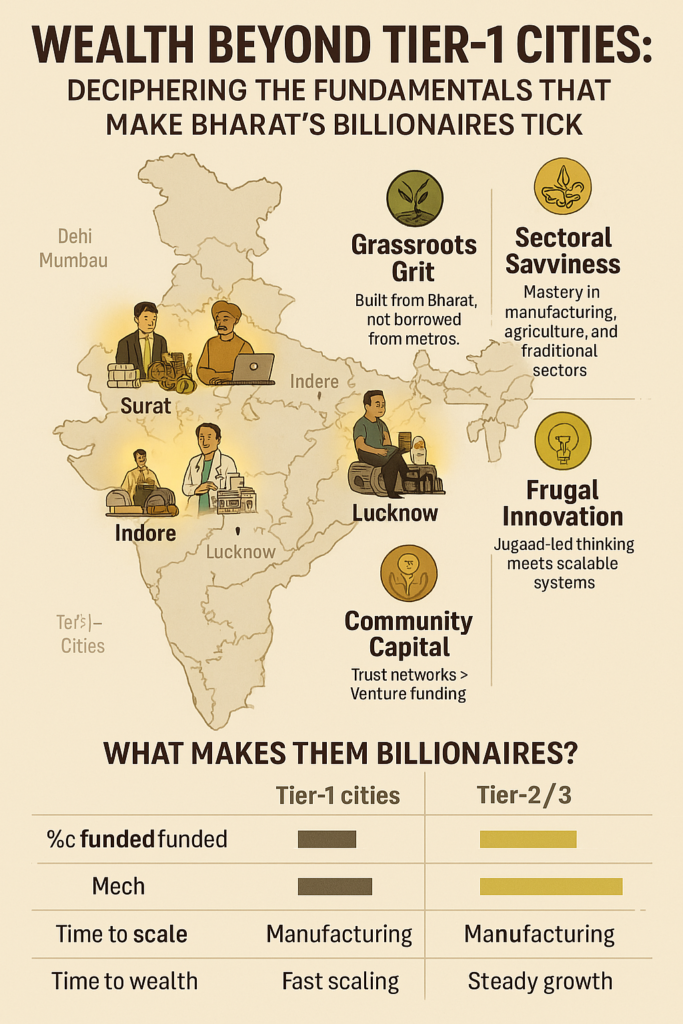
Billionaires of Bharat: Beyond the Metro Mirage 🌆➡️🌾
Not born in boardrooms.
Not boosted by big-city VC buzz.
Bharat’s billionaires rise from Tier-2 & 3 cities — where:
🔹 Grit > Glamour
🔹 Factories > Fintech
🔹 Jugaad > Jet-setting
🔹 Trust > Traction
From Ludhiana to Surat, they build legacy with local roots and global reach.
Real wealth. Rural resolve. Bharat-built.
#BharatBillionaires #WealthBeyondMetros #Tier2Success #MadeInIndia
Agar chaho toh isi tone mein ek reel voiceover script, LinkedIn carousel, ya poster text bhi bana sakta hoon. Let me know what format you’re targeting!